The Nobuko Stitch
The Nobuko stitch is one of the most useful background stitches in needlepoint: a diagonal stitch worked in horizontal rows that covers ground quickly, sits flat, and reads as texture rather than pattern. If you have a large sky, a stretch of water, or an expanse of animal fur to fill, this is one of the first stitches worth considering.
The stitch is a modern one. It was created by the American stitcher Charlotte “Chottie” Alderson, who named it after a close friend and fellow stitcher, Nobuko.
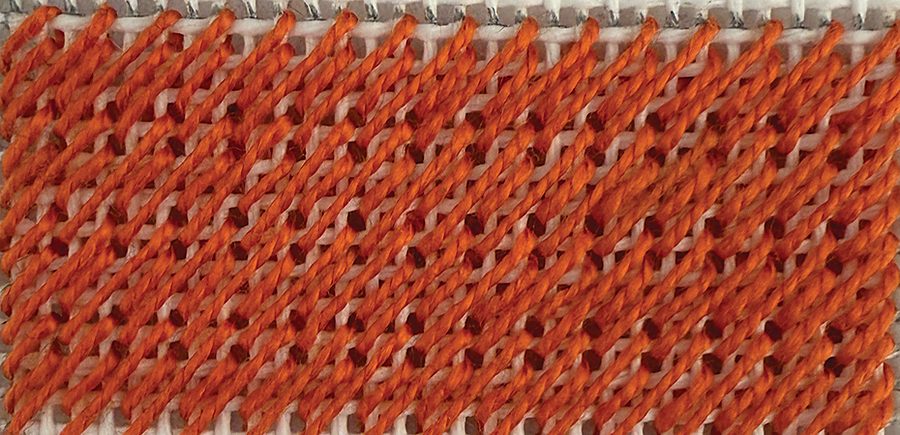
Nobuko. The diagonal reads as texture rather than pattern.
On this page
- What the Nobuko stitch looks like on the canvas
- What the Nobuko stitch is good for
- How the Nobuko stitch behaves across mesh counts
- Nobuko stitch variations
- Compensating the Nobuko stitch
- Where to find the Nobuko stitch chart and video
- Alternatives to the Nobuko stitch in Volume 1
- More on choosing needlepoint stitches
What the Nobuko stitch looks like on the canvas
Worked in rows, Nobuko produces a soft diagonal ripple across the surface. It is designed as a full-coverage stitch: worked with enough plies, the long stitches of one row meet the short stitches of the row before and no canvas shows. Work it thin and the ground shows through, and the surface reads as texture rather than a solid block of colour. Which of those you get is decided by thread weight, not by the stitch.
The effect changes noticeably with thread. A matte wool fills the gaps and mutes the diagonal; a silk or a stranded cotton laid flat catches the light along the diagonal and sharpens it considerably. On the same canvas, in the same colour, those two threads produce very different-looking backgrounds.
What the Nobuko stitch is good for
- Skies — the diagonal reads as movement without drawing the eye
- Water — particularly with a slight colour shift between rows
- Animal fur and snow — the texture suggests depth on what would otherwise be flat areas
- Any large, open background where basketweave would feel heavy and lifeless
It is less suited to narrow strips and awkward shapes. Because the repeat runs on the diagonal, a tight or irregular area forces a lot of compensation, and the pattern never gets the space it needs to establish itself.
How the Nobuko stitch behaves across mesh counts
Needlepoint canvases generally run from 10 to 18 mesh — the count is the number of holes per inch, so a lower number means larger holes and a more open ground.
The same stitch is roughly half the physical size on 18 mesh that it is on 10. In practice that means Nobuko reads as a bold, obvious texture on coarse canvas and as a subtle, almost tweedy surface on fine canvas. Neither is wrong — but if you are choosing a stitch from a photograph taken on a different mesh count than yours, expect it to look different on your canvas.
On finer counts you will usually want more plies than you think, because the openness that looks good on 13 mesh can look thin and unfinished on 18.
Nobuko stitch variations
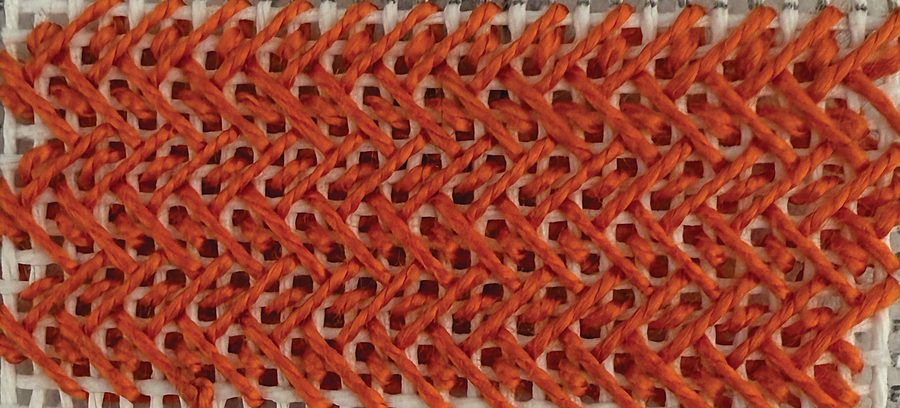
Alternating Nobuko — the diagonal reverses between rows, evening out the surface.
Alternating Nobuko reverses the direction of the diagonal between rows, which breaks up the ripple and produces a more even, less directional surface. It is the better choice when the background runs in several directions around a motif, or when a strong diagonal would fight the design.
Both are in Background Stitches Volume 1, charted and worked on video.
Compensating the Nobuko stitch
Backgrounds rarely divide neatly into whole repeats. Where a full stitch will not fit against an edge or a painted shape, you work a partial one — a compensation stitch.
The Nobuko stitch compensates reasonably well, because the individual stitches are simple enough to shorten without the eye noticing. The place it gets awkward is a curved painted edge, where you are compensating on every row and the diagonal starts to look ragged. If most of your background boundary is curved, a smaller-scale stitch will give you a cleaner edge.
Where to find the Nobuko stitch chart and video
The numbered chart for Nobuko, a photograph of the finished stitch, and a video of it being worked start to finish are all in Stitch School: Background Stitches Volume 1 — along with 44 other background stitches.
The book is $24. That single price includes the complete PDF to download and keep, plus a full year of access to the video lesson for every stitch in it. See what is in Volume 1.
Alternatives to the Nobuko stitch in Volume 1
If the Nobuko stitch is not quite right for your area, these are the closest alternatives in the same volume:
- Alternating Nobuko — same scale, less directional
- Hungarian — a similar mid-scale texture with a more regular, less diagonal rhythm
- Mosaic — smaller repeat, better for tight or broken-up areas
- Diagonal Mosaic — keeps a diagonal feel at a smaller scale
More on choosing needlepoint stitches
- Which needlepoint stitch should I use for a background?
- Mosaic vs Scotch: which should you use?
- All needlepoint stitches in this reference
Stitch School is published by AMK Publications, who also produce Needlepoint Now magazine.