Needlepoint Stitches: A Working Reference
This is a reference to decorative needlepoint stitches — what each one is for, how it behaves on different canvas counts, and how to choose between two stitches that look almost identical in a chart. It answers which stitch and why. The numbered charts and the step-by-step videos live in the Stitch School books.
The stitches covered here are background stitches: the ones used to fill the open space around a painted or charted motif — the sky behind the house, the water under the boat, the plain ground a design sits on. On most canvases that space is the largest area on the piece and the part that takes the longest to work.
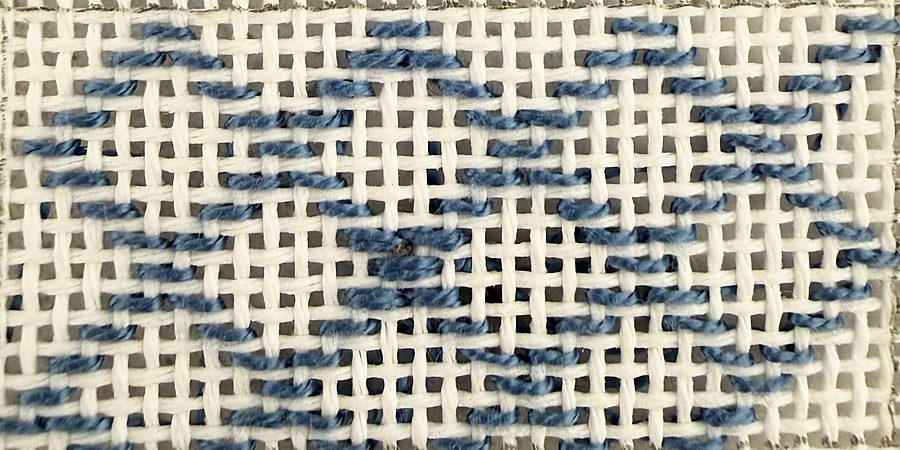
Open Diamonds — large-scale, and it needs a generous area to show a full repeat.
On this page
- Choosing a stitch
- Individual stitches
- The three things that decide every stitch choice
- Small, medium and large: the three families
- What is on these pages and what is in the books
- About this reference
Choosing a stitch
Start here if you are looking at an empty background and are not sure what to put in it.
- Which needlepoint stitch should I use for a background? — the decision worked through step by step: area size, mesh count, how loud the background should be, and how the stitch will handle your edges
- Mosaic vs Scotch: which should you use? — two block stitches that look alike on paper and behave very differently on canvas
Individual stitches
- Nobuko — a diagonal stitch worked in rows, well suited to skies, water, snow and fur
More needlepoint stitches are being added to this reference. All 45 background stitches are already charted and filmed in Volume 1.
The three things that decide every stitch choice
Almost every stitch that disappoints on a finished piece went wrong for one of three reasons.
Scale. A stitch needs room to show a complete repeat. Measure the narrowest part of your background, not the widest — if it will not hold two or three full repeats, the stitch is too large for that space no matter how good it looks in a photograph. You will spend the whole area working compensation stitches and the pattern you chose it for will never appear.
Mesh count. Canvases generally run from 10 to 18 mesh, meaning holes per inch, so a lower number is a coarser ground with larger holes. The same stitch is roughly half the physical size on 18 mesh that it is on 10. “Large” and “small” therefore describe needlepoint stitches on your canvas, never the stitch on its own — which is why a stitch chosen from a photograph shot on a different count so often surprises people.
Thread. A matte wool fills the canvas and mutes whatever pattern you chose. A silk or a stranded cotton laid flat catches the light along each stitch and sharpens it. The same stitch, in the same colour, on the same canvas, can be quiet or brilliant depending only on this. If you are undecided, work a small square on a scrap of the same mesh in the thread you actually intend to use.
Small, medium and large: the three families
It helps to think of background stitches in three groups, because the group tells you where a stitch will work before you look at anything else about it.
These groupings are the ones used in Background Stitches Volume 1, and they are relative to the 45 stitches in that book rather than to needlepoint as a whole.
Small stitches — Mosaic, T-Stitch, Skipped Tent and their variations. Close in scale to basketweave, dense, and forgiving. They slot into narrow strips, broken-up areas and tightly curved edges without a fight, and they sit quietly behind a detailed motif.
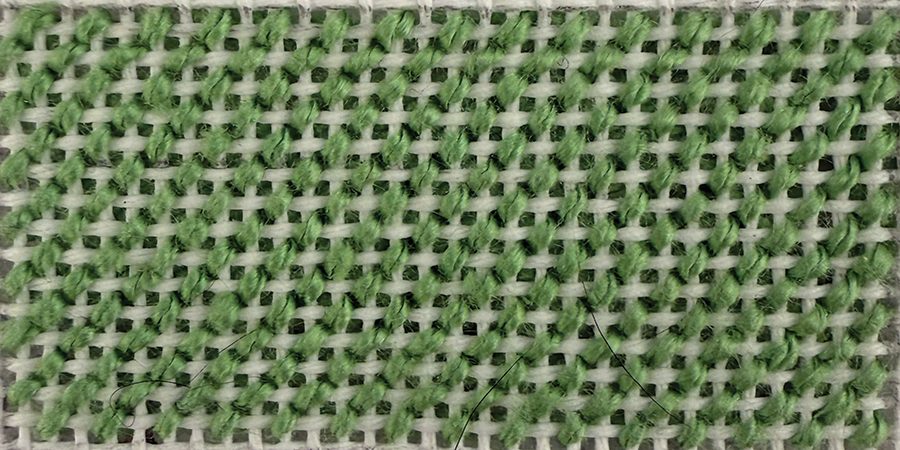
Skipped Tent — small-scale, and forgiving in narrow or tightly curved areas.
Medium stitches — Nobuko, the Hungarian family and their relatives. The everyday choice for a normal open background around a motif: enough texture to be interesting, not so much that it competes.
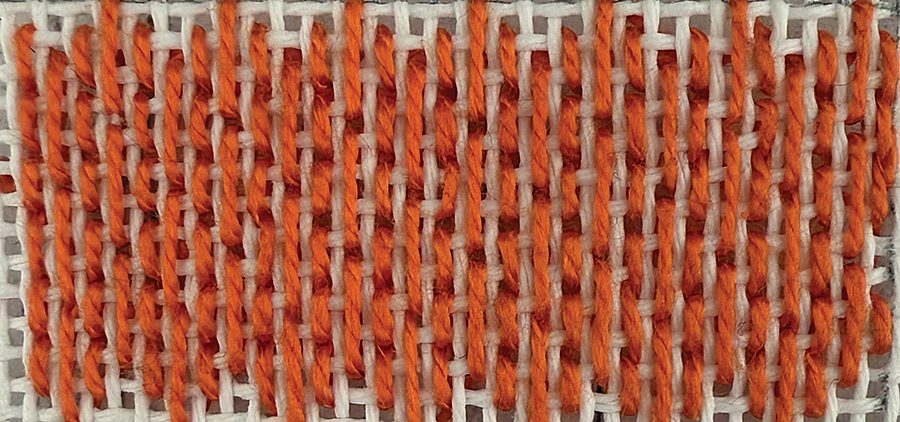
Hungarian — medium-scale, the everyday choice behind a motif.
Large stitches — Open Diamonds, Wide Diamond, Bargello Swing. Fast to work and visible from across the room, but they need generous, uninterrupted space. Behind a delicate design they can overwhelm; on a large plain ground they can carry the whole piece.
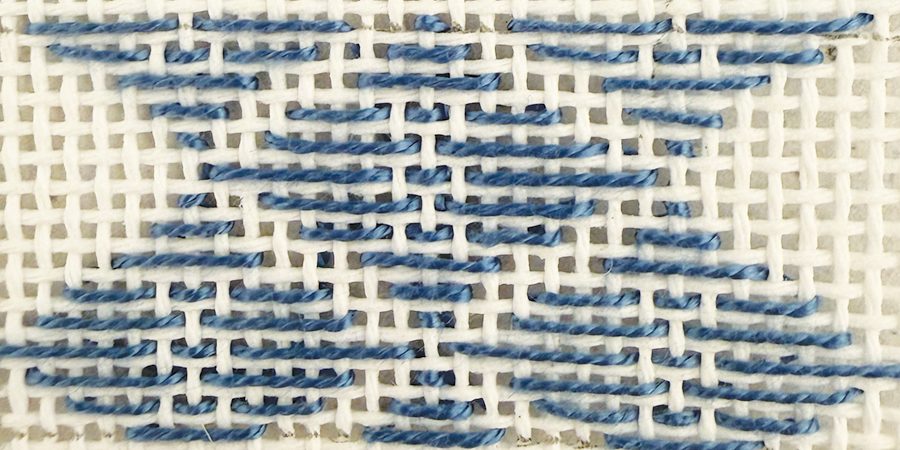
Wide Diamond — large-scale, and it needs room to show a full repeat.
Most background stitches are also open by design, meaning they let some canvas show through. On a bare white canvas that can look stark; on a painted canvas the ground beneath sits close to the shade of the thread and reads as depth rather than as a gap.
What is on these pages and what is in the books
These pages carry the reasoning: what a stitch is good for, how it scales across mesh counts, how cleanly it compensates against a curved edge, and which stitches are its closest alternatives. That is the part that is hard to find anywhere online.
The numbered chart for each stitch, a photograph of the finished stitch, and a video of it being worked from start to finish are in the Stitch School books. Background Stitches Volume 1 covers 45 needlepoint stitches for $24 — the complete PDF to download and keep, plus a full year of access to the video lesson for every stitch in it.
About this reference
Stitch School is published by AMK Publications, who also produce Needlepoint Now magazine. The needlepoint stitches described here are drawn from more than twenty-six years of stitch guides charted and published in the magazine. More about who we are.