
Mosaic vs Scotch Stitch: Which Should You Use?
The Mosaic stitch and the Scotch stitch are both diagonal block stitches, both worked over a small square of canvas, and both used constantly for backgrounds. They look similar in a chart and behave very differently on a finished piece. The difference comes down to one thing: scale.
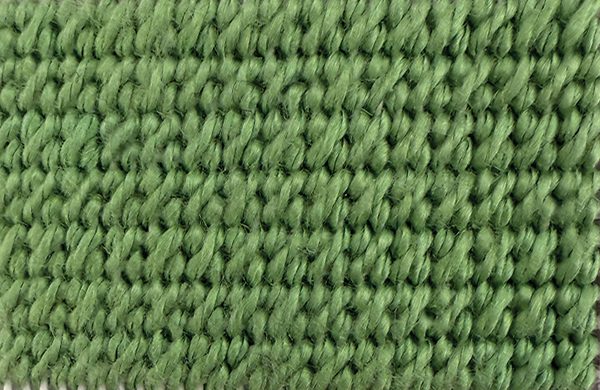
Mosaic — a small block that fills densely and sits quietly behind a motif.
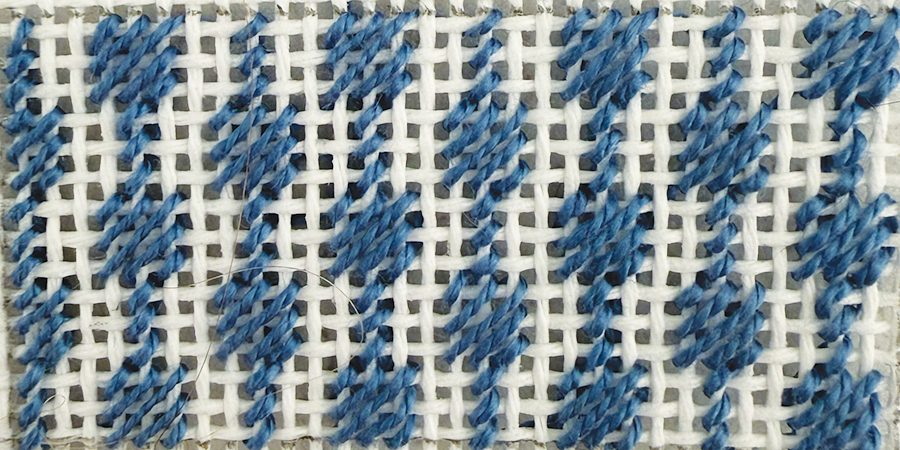
The Scotch Tent Variation — a larger block framed with tent stitch. Compare how much more canvas one repeat covers.
The thread colours differ because these two come from different sections of Volume 1. What to compare is the size of one repeat against the canvas beneath it.
On this page
- Mosaic or Scotch stitch: the short answer
- How the Scotch stitch differs from Mosaic in practice
- How to decide before you commit thread
- What the Mosaic and Scotch stitch each do to a design
- Mosaic and Scotch stitch variations worth knowing
- Thread makes more difference than you expect
- Where to find the Mosaic and Scotch stitch charts
- More on choosing needlepoint stitches
Mosaic or Scotch stitch: the short answer
- Choose Mosaic when the background is broken up, narrow, or bordered by a curved painted edge — anywhere a large repeat would spend more time being compensated than being seen.
- Choose the Scotch stitch when you have a generous open area and want the texture to be visible from across the room.
One note on names before going further. Background Stitches Volume 1 charts the Scotch Tent Variation — the Scotch block framed with tent stitch — rather than plain Scotch. Everything below about scale, compensation and thread applies to both, because the block at the centre of them is the same.
How the Scotch stitch differs from Mosaic in practice
Mosaic is a small block. It fills densely, holds fine detail, and sits close in scale to basketweave — which means it slots into awkward spaces without a fight. You can run it into a curve, compensate the edge, and the eye will not catch the join.
The Scotch stitch is a larger block covering more canvas per repeat. That makes it faster to work and considerably more dramatic, but it needs room. Drop the Scotch stitch into a narrow border and you will compensate nearly every repeat, the blocks will never complete, and the pattern you chose it for will not appear at all.
This is the single most common stitch-selection mistake: choosing a large stitch for the way it looks in a photograph, without checking whether the area is big enough to show a full repeat.
How to decide before you commit thread
Measure the narrowest part of the area you are filling, not the widest. If that measurement will not accommodate at least two or three complete repeats of the stitch, the stitch is too large for the space.
Mesh count feeds into this directly. A Scotch stitch block on 10 mesh is roughly twice the physical size of the same block on 18 mesh. A stitch that is too large for an area on 13 mesh may be perfectly comfortable on 18 — so “too big” is never a property of the stitch alone, only of the stitch on your canvas.
What the Mosaic and Scotch stitch each do to a design
Mosaic is quiet. It gives a background surface interest without competing with the painted motif, which is why it is such a reliable default.
The Scotch stitch is assertive. The larger blocks create a strong, regular grid that becomes part of the design rather than a backdrop to it. On the right piece that is exactly what you want. Behind a delicate or highly detailed motif, it can overwhelm.
Mosaic and Scotch stitch variations worth knowing
Diagonal Mosaic runs the repeat on the diagonal, giving movement where plain Mosaic is static — useful for water and sky.
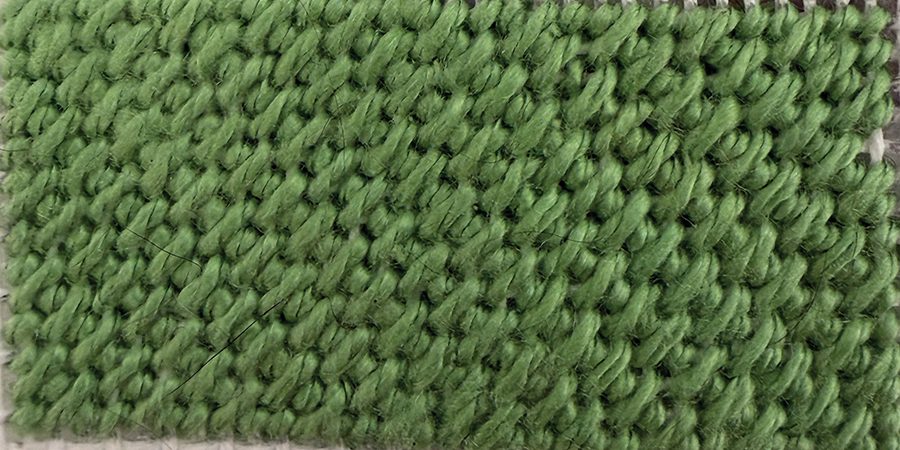
Diagonal Mosaic — the repeat runs on the diagonal, giving movement where plain Mosaic is static.
Alternating Mosaic shifts the direction between rows for a more broken, less regular surface.
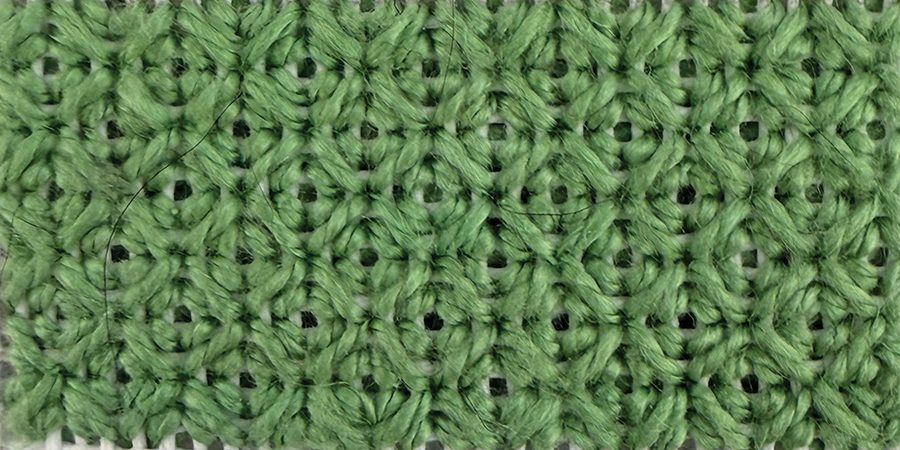
Alternating Mosaic — direction shifts between rows for a more broken surface.
Skipped Mosaic Variations open the stitch up so more canvas shows, which changes it from a filling stitch to an open one.
Scotch Tent Variation frames the Scotch stitch block with tent stitch, softening the grid and settling it into the surrounding work.
All of these are charted and worked on video in Background Stitches Volume 1.
Thread makes more difference than you expect
Both stitches change character with thread. A matte wool fills the blocks and mutes the geometry; a silk laid flat catches the light along each block and sharpens the grid considerably. If you are unsure, work a small square of each on a scrap of the same mesh, in the thread you actually intend to use. Ten minutes there saves an evening of reverse stitching.
Where to find the Mosaic and Scotch stitch charts
Volume 1 charts Mosaic and the Scotch Tent Variation — the Scotch stitch block framed with tent stitch — along with 43 other background stitches. Each one has a numbered chart, a photograph of the finished stitch, and a video of it being worked start to finish.
The book is $24, which includes the complete PDF to download and keep plus a full year of access to the video lessons. See what is in Volume 1.
More on choosing needlepoint stitches
- Which needlepoint stitch should I use for a background?
- The Nobuko stitch — a medium-scale diagonal alternative to both
- All needlepoint stitches in this reference
Stitch School is published by AMK Publications, who also produce Needlepoint Now magazine.